The same curiosity Marcus brings to projects runs through his teaching and LinkedIn posts. Explore the lessons, the original graphics and the thinking behind BPV.
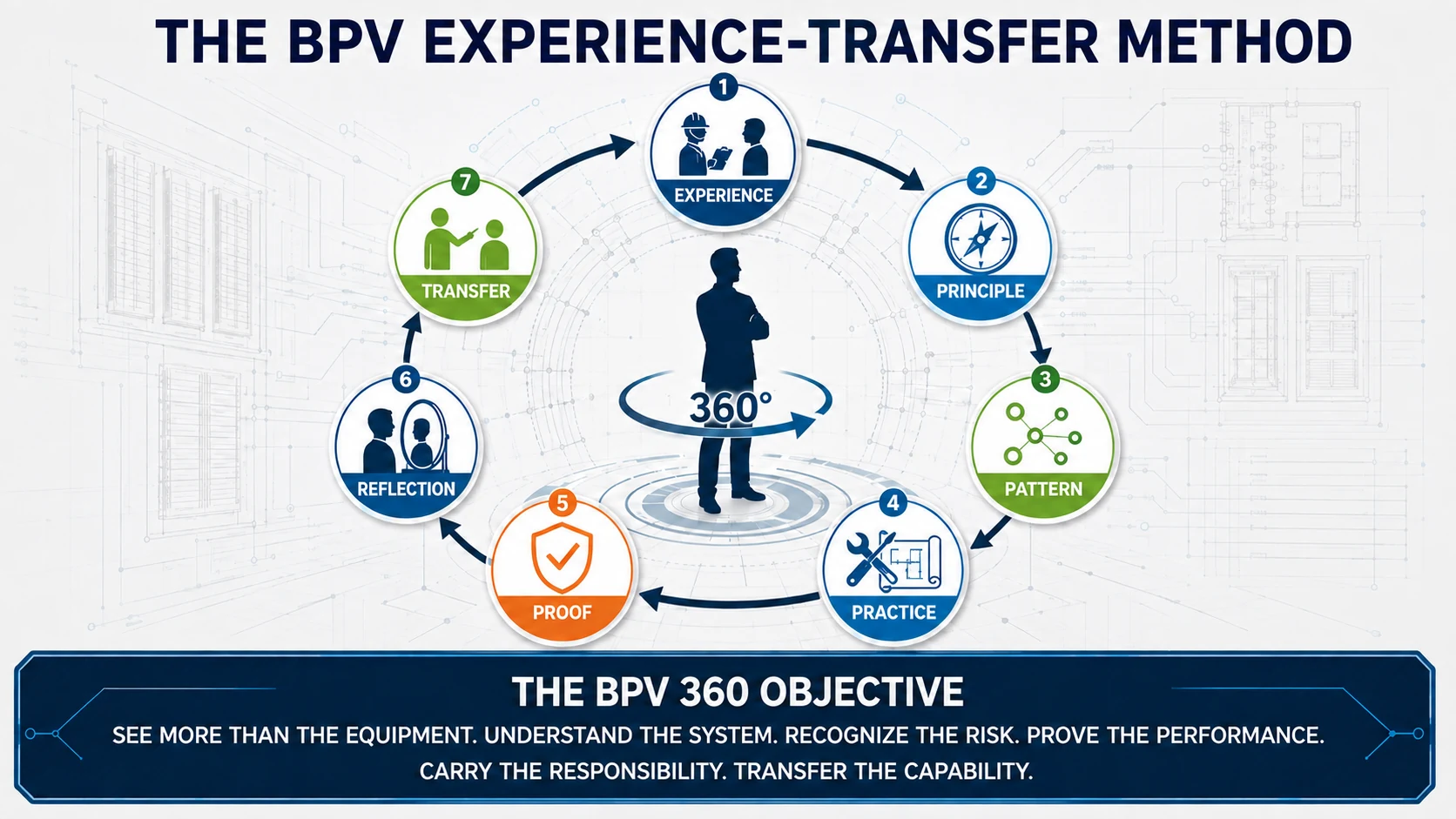
Start with a room that feels warm. Follow the seven circles to see how an everyday question becomes a way to think through technical work.
Explore the seven steps below. Each one connects the lesson to you.
01 / Experience
Start with what you know.
You already notice when something does not work as expected. That everyday habit gives you a place to begin learning the technical work.
A familiar connection
A room feels warm. The thermostat screen says 72°F. You notice a difference between what you feel and what you see.
Your turn to think
What do you actually know, and what are you assuming?
Explore the reasoning and your next step +
You know the room feels warm to you and the screen shows 72°F. You have not yet established whether that number is a measured temperature or the desired setting. Naming what you do not know gives your next question a purpose.
Try this next Describe the situation in two sentences. Separate what you observed from what you think might explain it.
02 / Principle
Find the idea behind the example.
A useful lesson gives you a way to think that you can use again. Here, the principle is to understand what information represents before relying on it.
A familiar connection
The number 72°F could be the temperature you asked for or a sensor reading. Those tell you different things.
Your turn to think
Does asking for a result prove that you got it?
Explore the reasoning and your next step +
A setting tells the system what you want. A measurement describes a condition at a particular location and time. Neither, on its own, tells the whole story about comfort or system performance.
Try this next Think of another setting you use every day. Name the requested result, then explain how you would check the actual result.
03 / Pattern
Recognize the connection.
Once you understand an idea, look for it somewhere else. Connections make unfamiliar work easier to approach, provided you also notice where the comparison stops.
A familiar connection
An oven set to 350°F has not necessarily reached 350°F. A room thermostat follows the same useful distinction between a requested condition and a measured condition.
Your turn to think
What carries over from the oven example, and what does not?
Explore the reasoning and your next step +
The distinction between a setting and a result carries over. The equipment, controls, operating conditions and checks are different. Recognizing a pattern helps you ask better questions; it does not replace learning the new system.
Try this next Pick a familiar example. Write one connection that helps explain the new idea and one limit of that comparison.
04 / Practice
Try the thinking. Get feedback.
You build understanding by working through a task and explaining your choices. A coach can help you catch a missed connection before it becomes a habit.
A familiar connection
In a training exercise, you receive a thermostat screenshot and a simple room diagram. Your task is to identify the setting, the reading and the location each refers to.
Your turn to think
What would you check first, and why?
Explore the reasoning and your next step +
Start by identifying what each value represents and which room or sensor it belongs to. Then compare the available information. If a label or location is missing, say what you need instead of filling the gap with a guess.
Try this next Explain your first three checks to someone else. Ask them to point out an assumption or a step they could not follow.
05 / Proof
Make your reasoning visible.
An answer becomes more useful when another person can follow how you reached it. Show the observations, comparisons and limits behind your conclusion.
A familiar connection
In this example, checking the display labels confirms that 72°F is the desired setting. You record the sensor reading, its location and the observation time.
Your turn to think
What evidence supports your explanation, and what is still unknown?
Explore the reasoning and your next step +
Clear labels and traceable observations support the explanation of what the display means. They do not, by themselves, prove the cause of discomfort. Evidence should support the claim you are actually making.
Try this next Write one conclusion, list the information supporting it and identify the next fact you would need before going further.
06 / Reflection
Notice what changed your thinking.
You learn more from an exercise when you look back at the decision, not just the answer. Useful feedback tells you what to repeat and what to improve.
A familiar connection
At first, you assumed the room was 72°F. Checking the label showed that you had read the desired setting as a measurement.
Your turn to think
Which assumption changed, and what will you do differently next time?
Explore the reasoning and your next step +
The useful change is a specific habit: check what a value represents before using it. Missing that distinction in practice gives you something concrete to improve. You can try again and see whether your reasoning is clearer.
Try this next Finish this sentence: “Next time, before I conclude ___, I will check ___.” Then use that check in another example.
07 / Transfer
Take the lesson somewhere new.
Learning starts to travel when you can apply the idea in a different situation and help someone else understand it. A new context also gives you something new to learn.
A familiar connection
A building controls screen says a fan is on. You ask whether that means a command was sent, a status signal was received or airflow was measured.
Your turn to think
What does “on” mean here, and what would show the intended result?
Explore the reasoning and your next step +
A command, a status signal and a measured result represent different information. Their relationship depends on the system and its required operation. Your everyday question now helps you begin reading a sequence of operations and following the evidence.
Try this next Choose a new example from your work or daily life. Explain the requested action, the expected result and the evidence you would look for. Bring the parts you cannot yet explain to your coach.
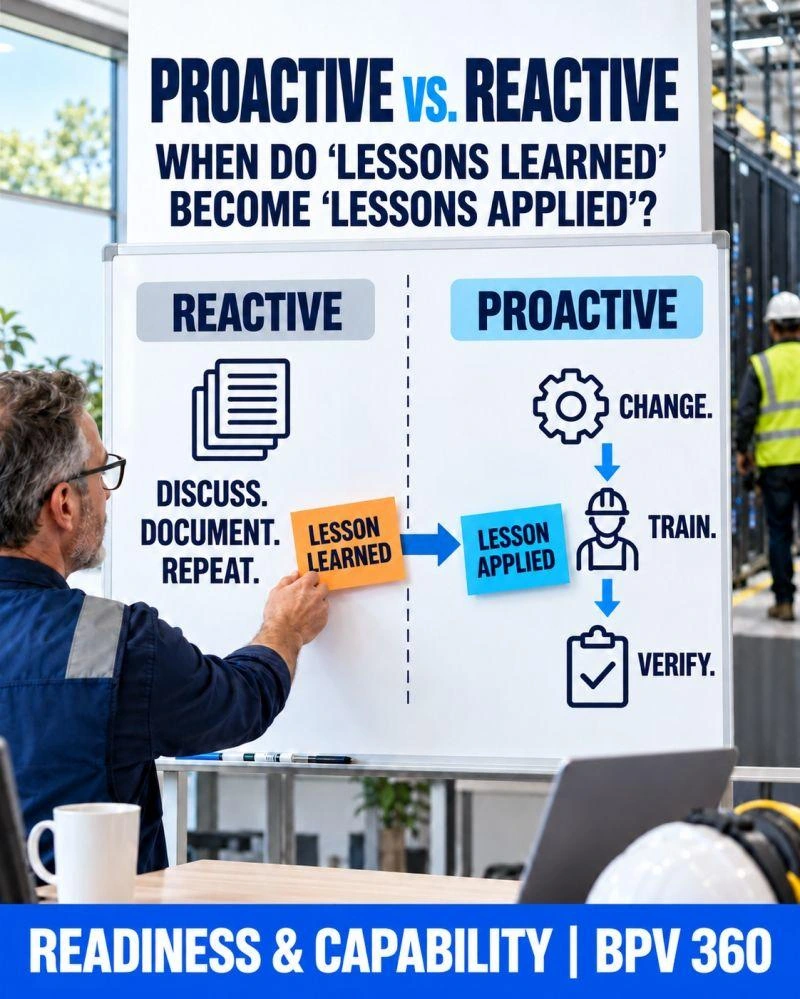
A familiar example can make an unfamiliar technical idea easier to understand. I use stories and analogies to help people recognize the connections, then practice applying the lesson.
Try it with your team
Choose one unfamiliar concept. Explain it using something you already understand, then ask where that comparison stops being useful.
Does understanding the example mean you have mastered the task?
Understanding is a starting point. Practice, feedback and evidence show whether you can apply the lesson. An analogy helps explain the idea; you still need to check the real requirements and conditions.
Adapted from Marcus’s teaching and LinkedIn writing.
Lessons from Marcus’s LinkedIn writing
Find an idea. Put it to work.
Start with the featured field lesson, then explore a subject that fits where you are. These short summaries connect the original posts with practical questions, training and a conversation with Marcus.
17 lessons
Starting out · Changing careers · Growing your skills
Learn to see what experience teaches.
A new technical idea makes more sense when it connects to something you already understand. Stories, examples and practice give you a place to begin.
Think it through
What is one idea you understand better when someone connects it to a real example?
Learning Cx connects building systems, controls, construction quality and operations. Asking why helps you understand the decisions beyond your own task.
Think it through
Which part of a project do you want to understand beyond your current role?
Changing careers · Growing your skills · Developing a team
People skills belong in technical work.
Listening, asking useful questions and coordinating with others help technical teams work toward a shared result. These are skills worth practicing too.
Think it through
When has listening or asking a better question helped your team solve a technical problem?
Changing careers · Growing your skills · Developing a team
Your next step may build on the work you already know.
Trade, facilities and project experience can provide a foundation for a new responsibility. Define the skills the new role needs, then connect learning with supported practice.
Think it through
Which part of your experience could help you contribute in a different role?
A strong résumé opens a conversation. Use realistic questions, guided learning and practical evidence to understand a person’s skills and development needs.
Think it through
What task would help you understand how a candidate thinks and works?
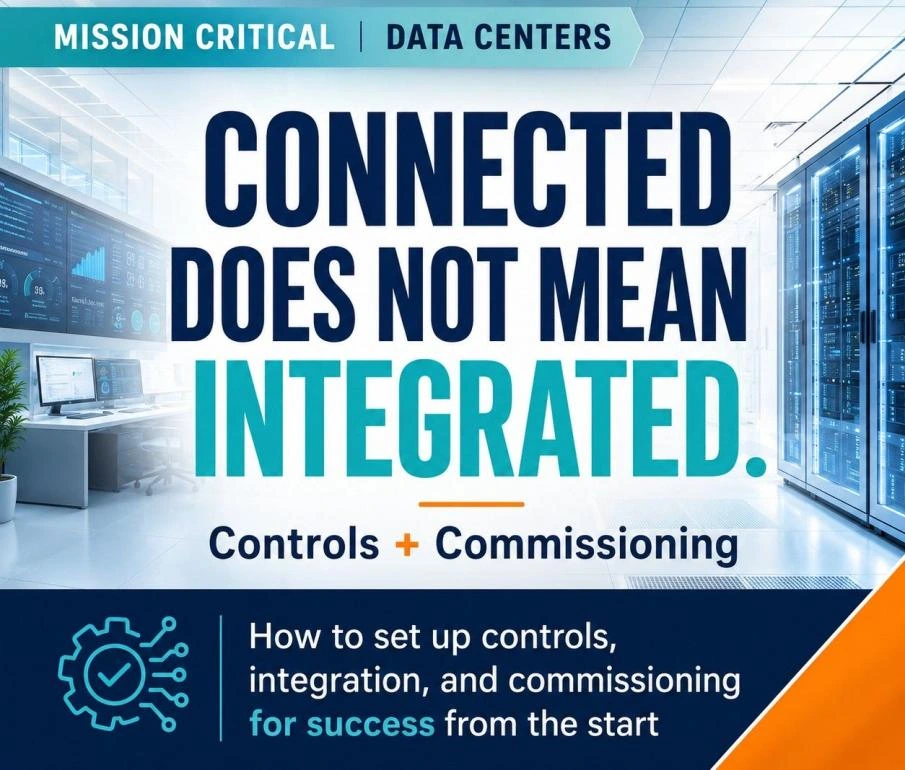
A master systems integrator follows the connections between equipment, controls, networks and operations. Clear responsibilities help each team hand something useful to the next.
Think it through
Who owns each handoff between the equipment and the information your operator receives?
Starting out · Changing careers · Growing your skills
Everything touches something else.
Mechanical, electrical, controls, the building enclosure and energy performance are connected. Curiosity helps you look beyond your own task and understand what the next person needs.
Think it through
If one part of your system changes, what else might change with it?
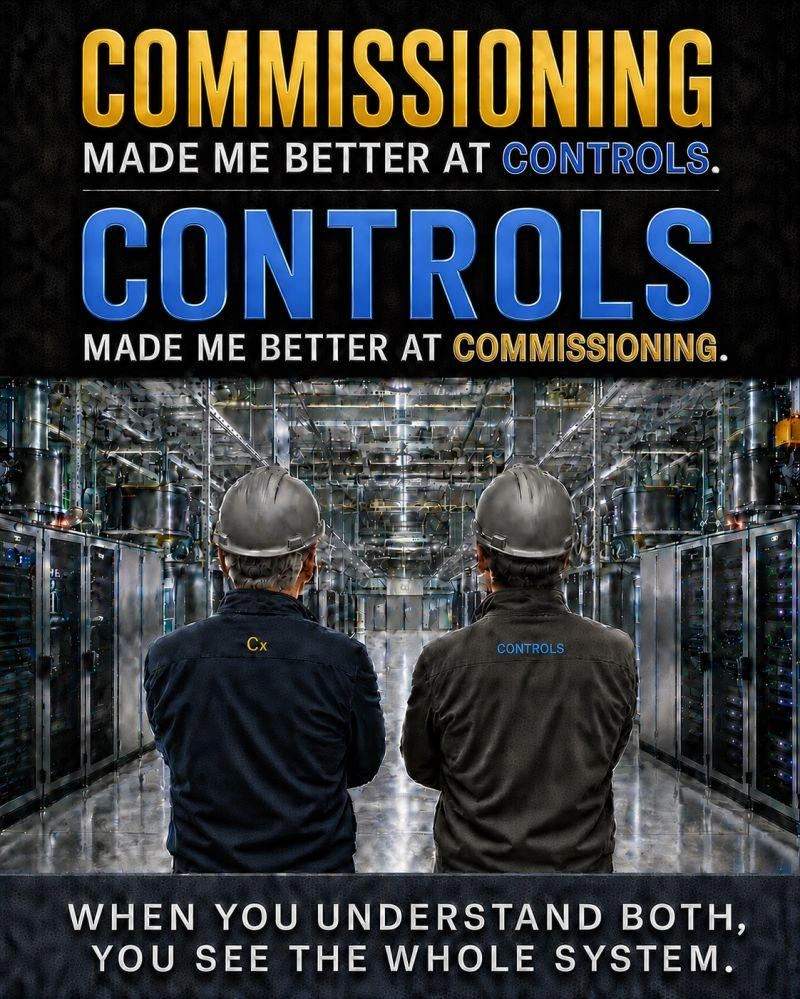
The hybrid Cx professional connects physical systems, controls, data and operational needs. Technical knowledge becomes more useful when you can also coordinate people and explain what the evidence means.
Think it through
Which connection between the physical system and its data would make you more effective?
Division 25 is more useful when the team understands the intended result, responsibilities, interfaces and acceptance evidence. Define those expectations early enough to guide the work.
Think it through
Could two different teams read your integration requirements and agree on who delivers and verifies each result?
Starting out · Growing your skills · Developing a team
Can you defend the data?
More data does not automatically produce better decisions. Marcus’s Data Assurance Cx approach asks what information matters, where it comes from and what evidence makes it trustworthy.
Think it through
What would you check before using a dashboard value to make an operating decision?
Starting out · Growing your skills · Developing a team
Build the OPR with the people who will use it.
Bring owner goals, space needs, performance, operations and integration into the conversation. Keep the requirements useful and current as decisions develop.
Think it through
Whose operating need is missing from your OPR conversation?
Starting out · Growing your skills · Developing a team
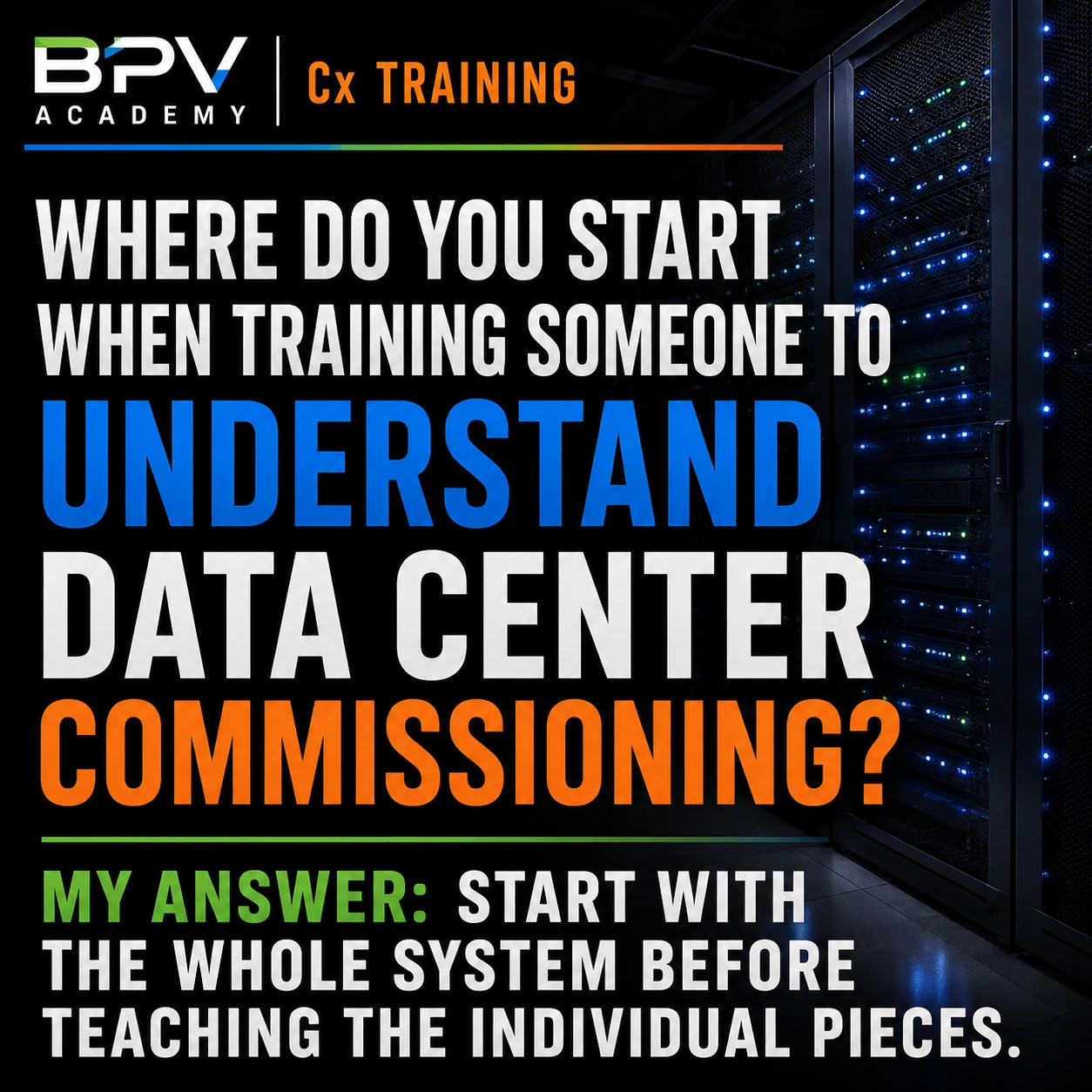
Define what success means for a data center.
Explore the operating boundaries, outage expectations and acceptance evidence behind a critical-facility requirement. Establish the criteria before treating a design choice as the answer.
Think it through
Which operating condition would expose an assumption in your requirement?
Starting out · Growing your skills · Developing a team
Make the design reasoning visible.
Connect the owner’s requirements to the design approach, assumptions and supporting information. Understand why a proposed system should meet the need.
Think it through
Can you trace one owner requirement to a design decision and the reasoning behind it?
No lessons match this selection. Choose another starting point.
Learn the connections
Know your part. Understand what it affects.
I teach people to connect their own work with the systems and people around them. Explain your reasoning, check the evidence and recognize when you need another discipline’s help.
A BPV example to discuss
The control screen says the cooling pump is ON. Is water reaching the equipment?
The display is one piece of information. First, clarify whether it shows a command, a status signal or a measured result. Then consider what else you need to know.
Connect the control command with the pump’s actual response, the water path and the equipment that needs cooling. Identify which parts depend on electrical, mechanical or controls knowledge.
What would support your answer?
Clarify what the displayed point represents. Compare the expected response with relevant measurements and observations under the agreed test conditions. Explain what is known and what still needs verification.
Who needs to be involved?
Name the people responsible for the affected systems. Explain the impact, document the open question and seek the right support when a decision goes beyond your authority.
Discussion exercise. Actual field work follows approved procedures, qualified supervision and the learner’s authorized scope.