BPV Academy · Training. Coaching. Team development.

Building Better
Buildings.
Developing
Better People.

You can learn this.
Let’s make it make sense.

BPV Academy trains people to understand, test and improve building performance. Explore practical lessons here, then build a training plan with us. We start with what you know and use familiar examples, guided practice and feedback.

For new entrants, career changers, experienced professionals
and the leaders developing them.

Explore the connections
Learn the system.Apply the principles.Prove the capability.

A short lesson with Marcus

Let’s work
through it.
Together.

Start with something familiar. Ask a question. Then connect it to the work.

Not sure yet? That is a perfectly good place to begin.

Bring your question to Marcus How small steps build understanding See how everyday thinking connects to technical work

01 / Start with what you know

You turn the shower handle.

Imagine you want a comfortable shower. Does turning the handle prove you got one?

The actionHandle turnedThe result?Flow + temperature

What would you need to know?

The handle is turned. That should do it.

That tells us what you did. It does not tell us whether water arrived, or whether its flow and temperature are what you wanted. The action is a starting point. The result needs a check.

I would check the actual flow and temperature.

Exactly. You connected the action to the result you wanted. Turning the handle matters, but the water has to arrive and meet the need. Keep that distinction in mind for the next example.

I’m not sure yet.

That is a useful place to start. Imagine turning the handle and getting no water. The action happened; the result did not. What would tell you the shower was actually doing what you wanted?
02 / Bring that thinking into the work

The screen says “FAN ON.”

In this example, that label is a command to run. It is not feedback from the fan. Does it prove air is moving?

Command pointFAN ONResult to verifyRequired airflow

What does the command actually establish?

“FAN ON” proves the air is moving.

Easy to read it that way. In this example, though, FAN ON is the command: a request for the fan to run. We still need evidence of its response and the required airflow. First, ask what the displayed point actually represents.

I need evidence of the fan’s response and airflow.

Yes. Separate the command from the status, then check the result. A run-status signal may indicate operation; it does not by itself establish that the required airflow is being delivered. Compare appropriate evidence with the project’s requirements.

I’m not sure yet.

Connect it to the shower. The command is like turning the handle. A status signal reports something about the equipment’s response. Airflow is the result we still need to verify. Ask: “What does this point tell me, and what does it leave unproven?”

A thinking exercise. Actual checks follow the approved procedures and project requirements.

03 / Make it useful to you

You have a better question now.

“What does this tell me, and what still needs proof?” You can bring that question to a drawing, a control point or a project handoff.

What would help you take the next step?

I’m new. Help me build the foundation.

Start with the purpose of Cx and how the process fits together. You do not need to know every system before you begin asking useful questions.

Start with the Cx process
Give me a different example to work through.

Try the distinction in another situation. Explain your reasoning first, then compare it with the evidence. That is how you find the part that still needs work.

Try the BPV 360 example
I want to work through this with my team.

Have each person explain what the point proves before comparing answers. Different answers reveal where the team needs a shared understanding.

Practice together as a team
I’m not sure yet.

Start with the whole picture. Notice which part raises a question for you, then use that question to choose your next step.

See how the Cx process fits together

Keep practicing: Explain without notes try a new example check your reasoning revisit when needed.

Copy a practice prompt for your AI tool

This is a written prompt you can take to a separate AI tool. Review its answers against reliable sources. Use an invented example; do not upload confidential documents.

You can select and copy the prompt above.

BPV was created for you

What fits your work?

Start with where you are and what you want to do next. Choose your role and a goal. See a suggested training starting point, then explore the details or talk directly with Marcus.

01 Choose your role

02 What do you want to improve?

For people starting out, changing careers or building their next skill.

A useful training starting point

Start a new path

Build from the experience you already have. Work with Marcus to choose a useful starting point, understand the fundamentals and practice a task with support.

Topics we can work through

  • How building systems work
  • Technical terms connected to real examples
  • Guided practice and feedback

A useful training starting point

Build my technical skills

Choose a responsibility you want to understand better. Connect the lesson with practical examples and learn to explain the steps, evidence and reasoning behind your work.

Topics we can work through

  • Commissioning, controls and system connections
  • Role-relevant exercises
  • Individual coaching

02 What do you want to improve?

For general contractors, construction managers and field teams.

A useful training starting point

Get ready for testing

Learn to explain what must be complete before the next test can begin. Work through the records, responsibilities and unresolved issues that help determine whether testing can start.

Topics we can work through

  • Prefunctional checks (PFC)
  • Startup records and prerequisites
  • Readiness reviews

A useful training starting point

Connect installation and performance

Follow the work from installation checks to observed system performance. Understand how each trade’s records support the next check or test.

Topics we can work through

  • Testing, adjusting and balancing (TAB)
  • Controls and installation checks
  • Functional performance testing (FPT)

A useful training starting point

Improve project handoffs

Practice giving the next team clear records, responsibilities and open items. Use project examples to explain what is ready, what remains and who needs to act.

Topics we can work through

  • Issue closure and supporting evidence
  • Turnover records
  • Coordination exercises

02 What do you want to improve?

For universities, hospitals, campuses and other building owners.

A useful training starting point

Make our requirements clear

Learn to explain what the building must do and how the project team will demonstrate it. Connect your operating needs with design decisions and the criteria used to accept the work.

Topics we can work through

  • Owner’s Project Requirements (OPR)
  • Basis of Design (BOD)
  • Performance and acceptance criteria

A useful training starting point

Understand what we are accepting

Learn to read the records used to recommend testing or acceptance. Practice asking useful questions about results, unresolved issues and how the system is supposed to work.

Topics we can work through

  • Test records and observed results
  • Open issues and follow-up
  • Requirements linked to evidence

A useful training starting point

Prepare our people for handover

Connect the project’s records and training with the people who will operate the facility. Work through what operators need to understand, practice and locate in the project records.

Topics we can work through

  • Systems manuals and operating records
  • Operator training
  • Handover planning

02 What do you want to improve?

For commissioning providers and in-house Cx teams.

A useful training starting point

Build a consistent Cx process

Give your team a shared approach from the owner’s requirements through handover. Connect the process with the questions, records and decisions people need to handle in their roles.

Topics we can work through

  • ASHRAE Guideline 0 fundamentals
  • Cx planning and responsibilities
  • Test records linked to requirements

A useful training starting point

Strengthen integrated testing

Learn how connections between systems and team responsibilities affect the result. Work through what must be ready first, coordinated test scenarios and the evidence needed to judge performance.

Topics we can work through

  • System and data interfaces
  • Integrated test coordination
  • Acceptance evidence

A useful training starting point

Develop new technical staff

Help new hires and people entering from another discipline turn basic understanding into practical skills. Connect clear expectations with guided practice, coaching and review.

Topics we can work through

  • Building systems and controls foundations
  • Guided project practice
  • Reviewed work and useful feedback

02 What do you want to improve?

For people leading quality assurance and quality control.

A useful training starting point

Clarify who checks what

Help your team connect quality planning, installation checks and checks of system performance. Practice making responsibilities and review points clear before work reaches the next team.

Topics we can work through

  • Quality assurance, quality control and Cx roles
  • Responsibility matrices: who does what
  • Review and verification points

A useful training starting point

Write findings people can act on

Practice describing what was observed, the relevant requirement, who needs to act and the evidence needed to close the issue. Make the next action understandable to the person receiving the finding.

Topics we can work through

  • Installation records
  • Clear issue logs
  • Closure evidence

A useful training starting point

Improve readiness and handoffs

Make it clear what must be complete and which issues remain before work passes to the next team. Review how startup information and quality records help the teams agree whether the next activity can start.

Topics we can work through

  • Readiness reviews
  • Startup documentation
  • Coordinated handoffs

02 What do you want to improve?

For facilities staff, building operators and energy teams.

A useful training starting point

Trust our meters and data

Check what a measurement represents before using it to make a decision. Follow the information from its source to the display and practice recognizing a value that needs investigation.

Topics we can work through

  • What each meter measures
  • Units, scaling and timestamps
  • Energy Information Systems (EIS)

A useful training starting point

Investigate operating problems

Trace an operating concern from the field measurement through controls to the actual response. Compare observations with the expected operation and explain what to check next.

Topics we can work through

  • Operating sequences
  • Trends and alarms
  • System interfaces and responsibilities

A useful training starting point

Keep performance improving

Connect reliable operating evidence with improvements and follow-up verification. Learn to review performance over time and carry useful findings into the next operating decision.

Topics we can work through

  • Ongoing commissioning (Cx)
  • Monitoring-based Cx
  • Energy optimization

02 What do you want to improve?

For design professionals, engineers, architects and specification writers.

A useful training starting point

Connect design intent and verification

Connect the owner’s needs with design decisions and the evidence needed to verify performance. Practice making performance requirements understandable to the people who build, test and operate the facility.

Topics we can work through

  • Owner’s Project Requirements (OPR)
  • Basis of Design (BOD)
  • Design review and acceptance criteria

A useful training starting point

Coordinate systems and interfaces

Connect equipment requirements, controls and information across disciplines. Work through the connections between systems, responsibilities and checks that need to be clear in the project documents.

Topics we can work through

  • Division 25 and integrated automation
  • System interfaces and responsibilities
  • Usable data and acceptance evidence

02 What do you want to improve?

For electrical project, commissioning, controls and operations professionals.

A useful training starting point

Understand the power path

Follow how power moves through the facility. Use diagrams, records and scenarios to understand what must be ready, how equipment depends on other systems and how testing is coordinated.

Topics we can work through

  • Single-line diagrams and distribution
  • Switchgear, generators and backup power
  • Electrical commissioning (Cx)

A useful training starting point

Connect metering and integration

Trace a measurement from its source to the information an operator uses. Check what the data represents, its units, how readings are converted and when they were recorded before relying on the displayed value.

Topics we can work through

  • Metering and instrumentation
  • Electrical power monitoring systems (EPMS)
  • Energy Information Systems (EIS)

02 What do you want to improve?

For controls technicians, programmers, building automation teams and systems integrators.

A useful training starting point

Understand sequences and responses

Connect a sensor reading, a control decision and the equipment response. Work through practical examples so you can explain what should happen and what feedback would confirm it.

Topics we can work through

  • Building automation system (BAS) fundamentals
  • Sensors, sequences and control responses
  • Commands, feedback and trends

A useful training starting point

Make systems work together

Follow signals and data between equipment and software systems. Practice defining each connection, who is responsible for it, the expected response and how to verify it.

Topics we can work through

  • Master systems integration (MSI)
  • Division 25 and interface requirements
  • Naming, data quality and verification

02 What do you want to improve?

For recruiters, hiring managers and people developing technical talent.

A useful training starting point

Understand technical roles

Build the technical understanding to discuss what a role involves. Connect the job description with typical tasks, system knowledge and the questions that help clarify a candidate’s experience.

Topics we can work through

  • Cx, controls and construction quality roles
  • Responsibilities and practical work examples
  • Technical interview questions

A useful training starting point

Review readiness for a role

Work through role-relevant questions, example tasks and evidence a candidate can explain. Discuss the skills observed, support needed and remaining development needs.

Topics we can work through

  • Questions that reveal the reasoning
  • Example tasks and work evidence
  • Learning and development needs

02 What do you want to improve?

For energy managers, sustainability professionals and building-performance teams.

A useful training starting point

Find useful improvement opportunities

Connect energy use, building condition and operating needs before choosing an improvement. Practice using observations and analysis to explain what should be investigated and why.

Topics we can work through

  • Energy audit scope and depth
  • Operating schedules and loads
  • Improvement priorities and supporting evidence

A useful training starting point

Use metering and data with confidence

Understand what the meters measure and how the information reaches your analysis. Check units, timing and data quality before comparing performance or recommending a change.

Topics we can work through

  • Meter boundaries and energy information systems (EIS)
  • Units, timestamps and data quality
  • Performance comparisons and assumptions

A useful training starting point

Verify and sustain improvements

Define the expected improvement and the evidence needed to evaluate it. Connect operating trends, investigation and follow-up checks with a continuing commissioning process.

Topics we can work through

  • Performance baselines
  • Monitoring-based commissioning (MBCx)
  • Verification and ongoing review

02 What do you want to improve?

For supervisors, mentors and people responsible for staff learning and development.

A useful training starting point

Give new hires a clear starting path

Define what a new colleague needs to understand and practice in the role. Build a sequence of learning, supported tasks and review points that fits the person and the work available.

Topics we can work through

  • Role expectations and starting capability
  • Guided practice and supervision
  • Feedback and progress reviews

A useful training starting point

Help our mentors teach more clearly

Help experienced staff explain their reasoning and turn a task into a useful learning experience. Practice asking questions, reviewing work and giving feedback that tells the learner what to do next.

Topics we can work through

  • Explaining the thinking behind a task
  • Coaching questions and practical examples
  • Feedback tied to observed work

A useful training starting point

Build a team development plan

Connect your team’s responsibilities with the skills people need next. Choose learning priorities, agree practical exercises and review demonstrated progress with Marcus.

Topics we can work through

  • Role and skill priorities
  • Individual and team learning plans
  • Continuing coaching and review

Work directly with Marcus through training, coaching and practical exercises, in person or live online.

Choose how you learn

In person. Live online.
Through practical experience.

BPV offers classes, individual coaching and team development programs. Work directly with Marcus through questions, guided exercises and approved project examples that help you apply what you learn.

Why BPV?

Learn the work.
Understand the why.
Show what you can do.

BPV connects practical teaching, systems thinking and personal coaching. You work toward a clear task, practice with support and use feedback to improve your next attempt.

See individual, team and project learning options

Choose your path

How can BPV help you?

Choose the starting point that fits you. Explore training for yourself, development for your team or practical learning around a project.

You and your goal: choose your BPV training path Three starting points: build my skills through individual training, develop my team, or apply learning on a project. Each path links to its training page. YOU & YOUR GOAL Choose your starting point. 01 / I’m learning for myself. Build myskills Explore a new direction, strengthenyour technical knowledge or preparefor greater responsibility. Explore individual training 02 / I’m responsible for people. Develop myteam Help new hires, technical staff andfuture leaders develop the skillsyour organization needs. Find training for my team 03 / I need help with the work. Apply it ona project Use project drawings, systemquestions and coached practice tohelp people apply what they learn. Explore project learning

The core portfolio includes 64 module topics across eight tracks, with specialist training shaped around your goals.

Explore all eight training tracks 64 module topics

Your next chapter

Yes, you can.

New to the industry or ready for a new direction? Build understanding, practice with support and take a useful next step.

Try a learning question: air, power, controls and more Explore LEED, codes, standards and Cx levels

The BPV 360 effect

Everything touches
something else.

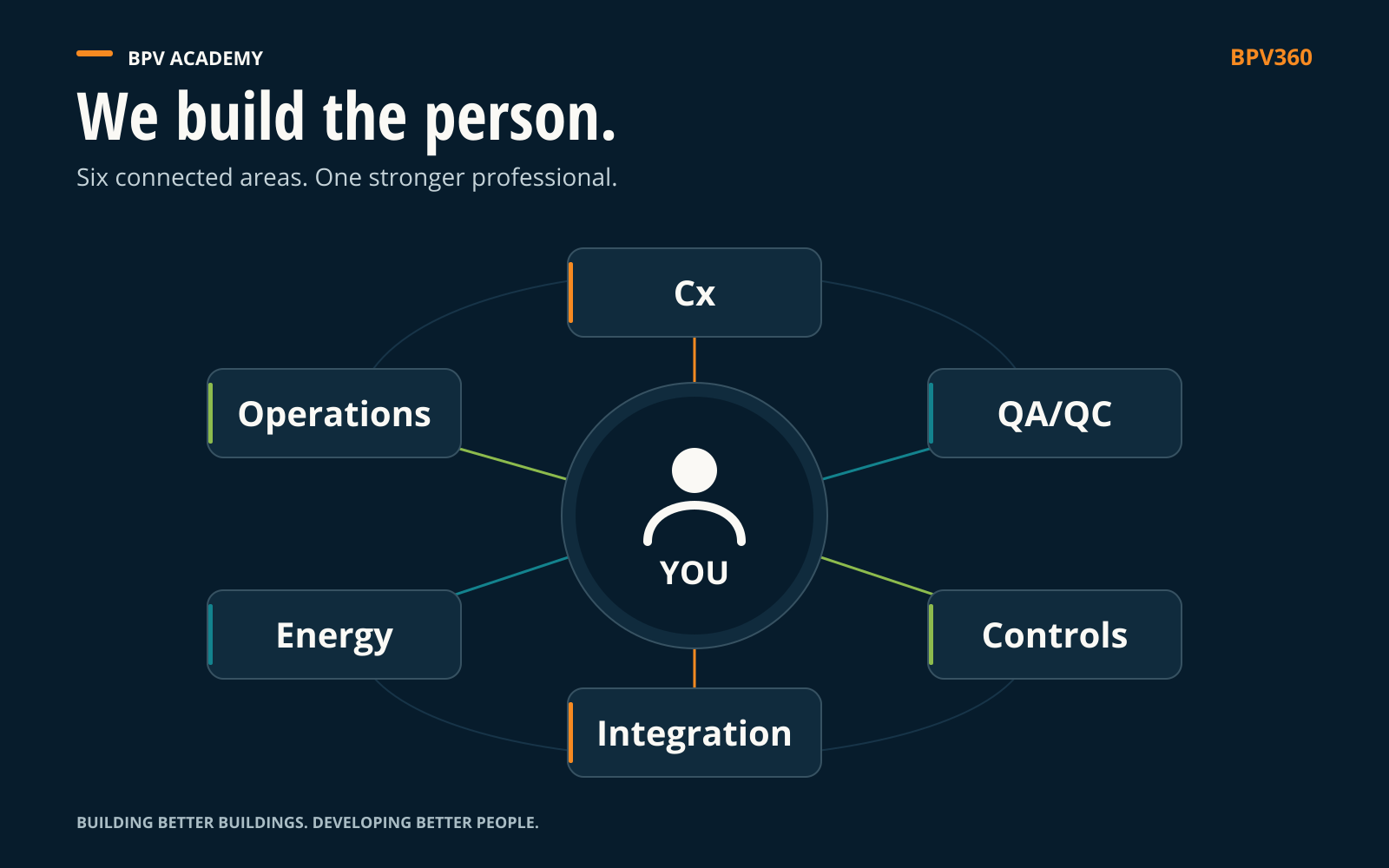
A building depends on more than individual pieces of equipment. I teach your team how quality, controls, energy and operations affect one another, and what each person needs to check before handing work to the next team.

BPV 360: you at the center of commissioning, quality assurance and quality control, controls, integration, energy and operations. A shared outer loop connects all six subjects.

Select a subject. Follow its link into the shared 360 loop and back to you.

Select a subject to explore its connection.

Your choice updates the lesson. The guided tour changes subjects every seven seconds.

Select a connected fundamental

Cx fundamentals

Practice the connection

What demonstrates understanding

Follow one example around the circle

A meter value becomes
an operating decision.

A plausible number on a screen is only one part of the story. Select a connection to see what the team needs to understand.

Open a topic to explore the work.

1 · Intent

Start with the decision.

What does the owner need to understand or improve? Define the measurement boundary, operating purpose and acceptance evidence.

Owner requirements → QA/QC planning and the integration scope.

2 · Quality & electrical

Know what is actually measured.

Review installation and instrument records. Confirm the meter source, equipment relationship and approved electrical verification evidence with the responsible specialists.

Installed equipment → a traceable, verified measurement.

3 · Controls

Check the path from field to controller.

Follow the value, scaling, units, update behavior and alarms. Compare the physical condition with what the controller reports.

Field measurement → control logic and a meaningful response.

4 · Division 25

Give the interface an owner.

Define who provides, maps and validates the point. Verify names, units, timestamps, quality and behavior if the connection fails.

Building automation, electrical monitoring and supervisory controls → usable information across systems.

5 · Energy

Make the information useful.

Compare reliable readings with loads, schedules and the operating baseline. Investigate a pattern before recommending an adjustment.

Trusted operating data → an informed performance decision.

6 · Ongoing commissioning

Verify the improvement. Keep learning.

Confirm the result against current facility needs. Update operating records and training, then feed the lesson into the next review.

Operating evidence → renewed requirements, quality checks and capability.

Close the circle. Operating evidence informs the next requirement, quality check, control adjustment and training need. The people and the building keep developing together.

Explore how Marcus teaches the connections

Your experience is a place to start

Follow a connection.
Build your understanding.

Start with a room that feels warm. Follow the seven circles to see how an everyday question becomes a way to think through technical work.

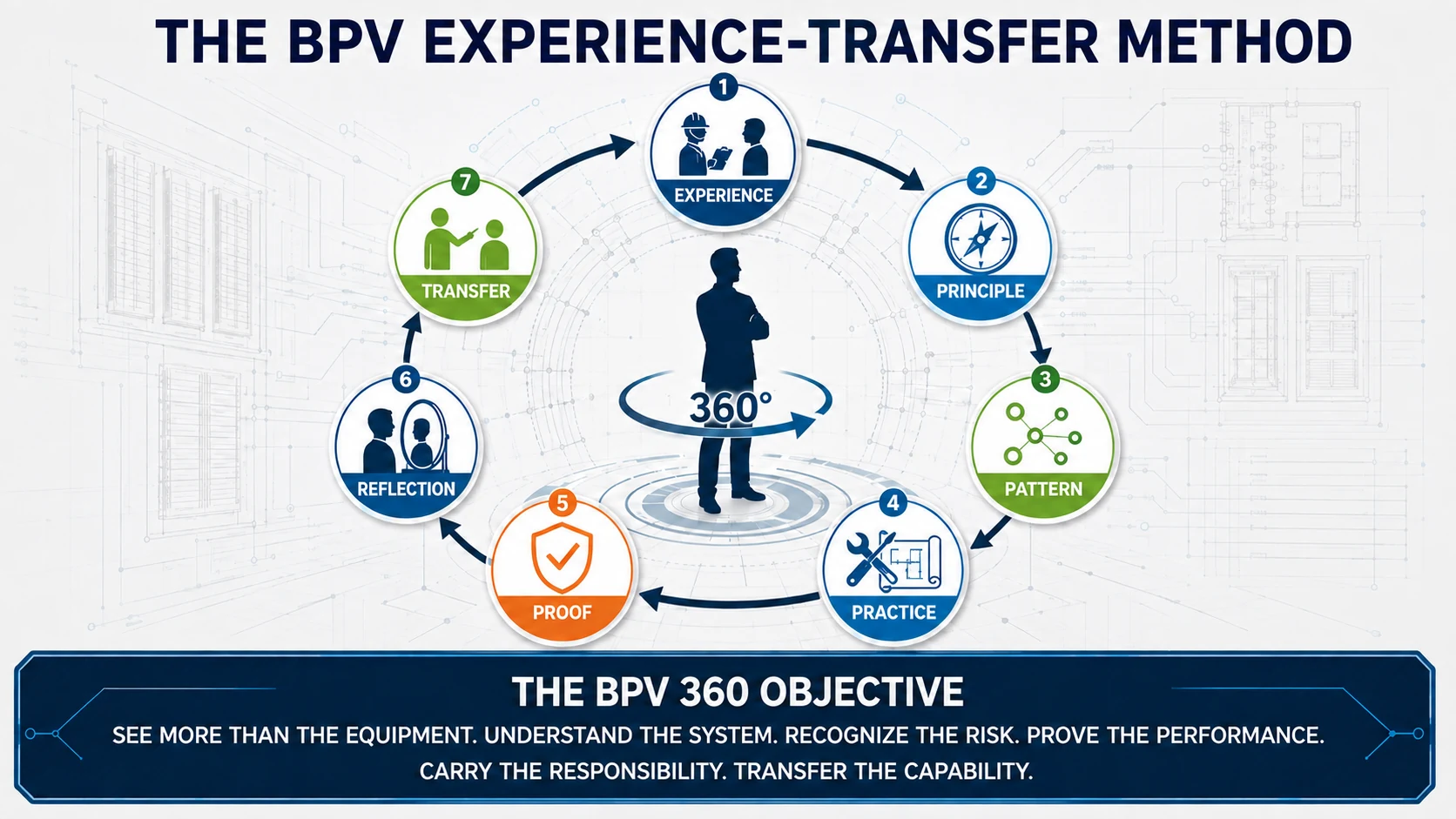
The BPV Experience-Transfer Method: experience, principle, pattern, practice, proof, reflection and transfer connected around the learner.
Explore the seven steps below. Each one connects the lesson to you.

01 / Experience

Start with what you know.

You already notice when something does not work as expected. That everyday habit gives you a place to begin learning the technical work.

A familiar connection

A room feels warm. The thermostat screen says 72°F. You notice a difference between what you feel and what you see.

Your turn to think

What do you actually know, and what are you assuming?

Explore the reasoning and your next step

You know the room feels warm to you and the screen shows 72°F. You have not yet established whether that number is a measured temperature or the desired setting. Naming what you do not know gives your next question a purpose.

Try this next Describe the situation in two sentences. Separate what you observed from what you think might explain it.

02 / Principle

Find the idea behind the example.

A useful lesson gives you a way to think that you can use again. Here, the principle is to understand what information represents before relying on it.

A familiar connection

The number 72°F could be the temperature you asked for or a sensor reading. Those tell you different things.

Your turn to think

Does asking for a result prove that you got it?

Explore the reasoning and your next step

A setting tells the system what you want. A measurement describes a condition at a particular location and time. Neither, on its own, tells the whole story about comfort or system performance.

Try this next Think of another setting you use every day. Name the requested result, then explain how you would check the actual result.

03 / Pattern

Recognize the connection.

Once you understand an idea, look for it somewhere else. Connections make unfamiliar work easier to approach, provided you also notice where the comparison stops.

A familiar connection

An oven set to 350°F has not necessarily reached 350°F. A room thermostat follows the same useful distinction between a requested condition and a measured condition.

Your turn to think

What carries over from the oven example, and what does not?

Explore the reasoning and your next step

The distinction between a setting and a result carries over. The equipment, controls, operating conditions and checks are different. Recognizing a pattern helps you ask better questions; it does not replace learning the new system.

Try this next Pick a familiar example. Write one connection that helps explain the new idea and one limit of that comparison.

04 / Practice

Try the thinking. Get feedback.

You build understanding by working through a task and explaining your choices. A coach can help you catch a missed connection before it becomes a habit.

A familiar connection

In a training exercise, you receive a thermostat screenshot and a simple room diagram. Your task is to identify the setting, the reading and the location each refers to.

Your turn to think

What would you check first, and why?

Explore the reasoning and your next step

Start by identifying what each value represents and which room or sensor it belongs to. Then compare the available information. If a label or location is missing, say what you need instead of filling the gap with a guess.

Try this next Explain your first three checks to someone else. Ask them to point out an assumption or a step they could not follow.

05 / Proof

Make your reasoning visible.

An answer becomes more useful when another person can follow how you reached it. Show the observations, comparisons and limits behind your conclusion.

A familiar connection

In this example, checking the display labels confirms that 72°F is the desired setting. You record the sensor reading, its location and the observation time.

Your turn to think

What evidence supports your explanation, and what is still unknown?

Explore the reasoning and your next step

Clear labels and traceable observations support the explanation of what the display means. They do not, by themselves, prove the cause of discomfort. Evidence should support the claim you are actually making.

Try this next Write one conclusion, list the information supporting it and identify the next fact you would need before going further.

06 / Reflection

Notice what changed your thinking.

You learn more from an exercise when you look back at the decision, not just the answer. Useful feedback tells you what to repeat and what to improve.

A familiar connection

At first, you assumed the room was 72°F. Checking the label showed that you had read the desired setting as a measurement.

Your turn to think

Which assumption changed, and what will you do differently next time?

Explore the reasoning and your next step

The useful change is a specific habit: check what a value represents before using it. Missing that distinction in practice gives you something concrete to improve. You can try again and see whether your reasoning is clearer.

Try this next Finish this sentence: “Next time, before I conclude ___, I will check ___.” Then use that check in another example.

07 / Transfer

Take the lesson somewhere new.

Learning starts to travel when you can apply the idea in a different situation and help someone else understand it. A new context also gives you something new to learn.

A familiar connection

A building controls screen says a fan is on. You ask whether that means a command was sent, a status signal was received or airflow was measured.

Your turn to think

What does “on” mean here, and what would show the intended result?

Explore the reasoning and your next step

A command, a status signal and a measured result represent different information. Their relationship depends on the system and its required operation. Your everyday question now helps you begin reading a sequence of operations and following the evidence.

Try this next Choose a new example from your work or daily life. Explain the requested action, the expected result and the evidence you would look for. Bring the parts you cannot yet explain to your coach.

Choose another circle ↑

This week’s field lesson ·

Connect the new idea to something you know.

A familiar example can make an unfamiliar technical idea easier to understand. I use stories and analogies to help people recognize the connections, then practice applying the lesson.

Try it with your team

Choose one unfamiliar concept. Explain it using something you already understand, then ask where that comparison stops being useful.

Does understanding the example mean you have mastered the task?

Understanding is a starting point. Practice, feedback and evidence show whether you can apply the lesson. An analogy helps explain the idea; you still need to check the real requirements and conditions.

Adapted from Marcus’s teaching and LinkedIn writing.

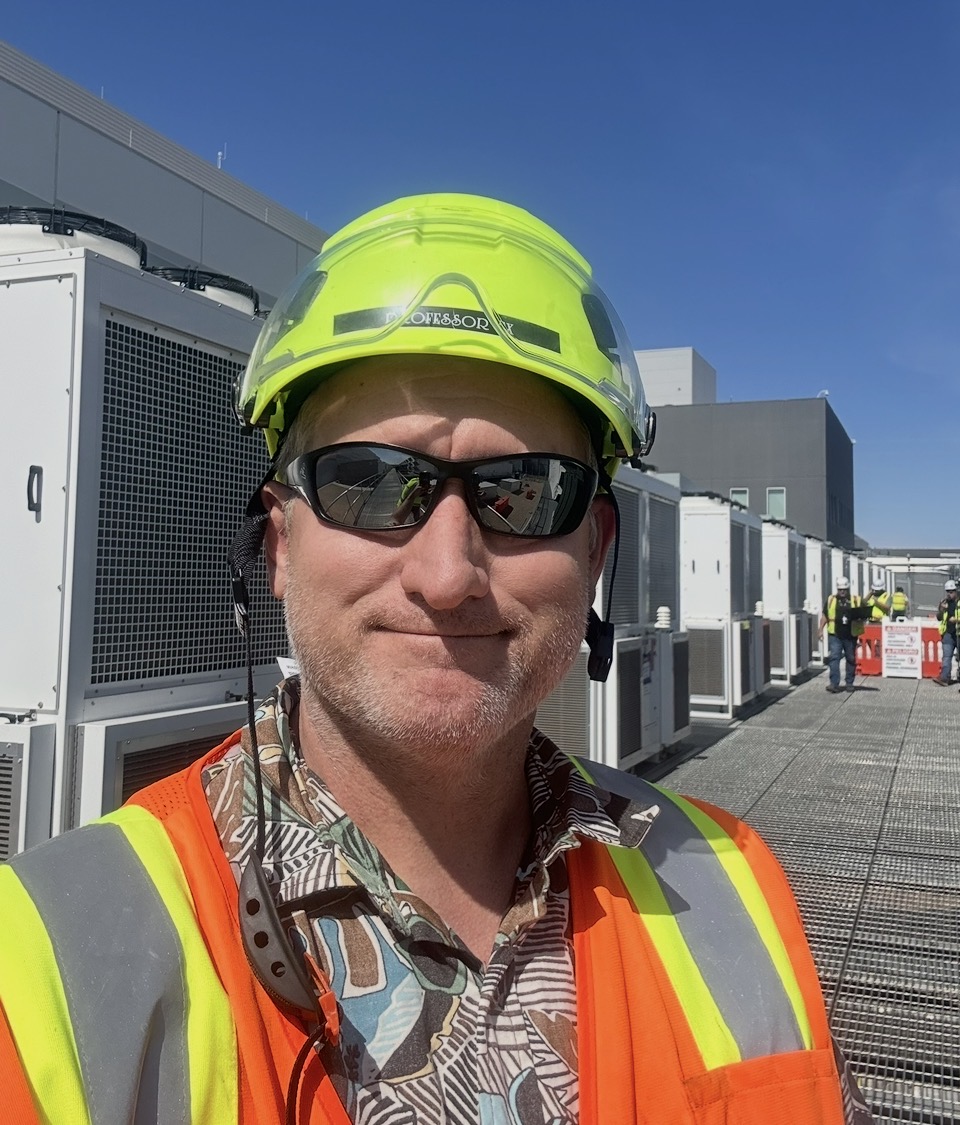
Marcus Myers in field PPE beside mechanical equipment
Marcus Myers · Practitioner, educator & mentor
Active field work informs the way I teach.
See the teaching and experience

My why

Experience should
help the next person.

“That is exactly why I teach and train today. So the next generation does not have to learn every lesson the hard way.”

I learned by doing the work, asking questions, making mistakes and listening to people who knew more than I did. I am still learning.

BPV is how I pass that experience on: help people understand the connections, develop their judgment and become someone their team can count on.

The practitioner. The teacher. The why.

The experience behind BPV

Founded by Marcus Myers.
Built from practical experience.

Marcus brings commissioning and energy leadership, controls and systems integration, university teaching and business ownership to BPV’s training.

His project and classroom experience shapes the practical instruction, coaching and feedback available to you and your team.

CxA · BECxP · CEM · LEED AP BD+C · Assoc. AIA · LFA

Practicing professionalPartner & CTO

Streamline Automation

Business ownerOwner & Founder

BPV Solutions · BPV Academy

Academic leadership & mentorshipBuilding Cx education
at Arizona State University

Introductory and advanced Cx curriculum · University teaching · Cx Devils mentorship

Explore the ASU teaching story
Industry expertiseASHRAE Leadership

Chair: 0.3P & 1.7P
Voting member: 1.6P & SSPC 300

Meet Marcus Myers Explore the ASHRAE work

Questions worth asking before we work together

Let’s make the next step clear.

What happens on the first call?

You tell Marcus about the people, their responsibilities and where the work gets difficult. Together, identify a useful starting point, possible training formats and the follow-up that would help. You do not need to choose a course before calling.

Can you work with our existing trainers and senior staff?

Yes. BPV can add structure, subject expertise, coaching and dedicated learning time alongside your internal mentors. Your team’s knowledge belongs in the program.

Are there existing modules, or do we start from scratch?

Start with BPV’s existing training material across 64 core module topics and eight tracks. The program is then shaped around your roles, systems, project requirements and starting experience. Specialist subjects and new needs are scoped with you.

How will we know the training is helping?

Agree the starting point and the task to demonstrate. Review explanations, work products and repeat performance, then track where support or correction is still needed. Managers and learners should be able to see what changed.

Does the relationship continue after the session?

That is the intention. Follow-up conversations, learner check-ins, coaching and mentoring can form part of a continuing partnership. Discuss the support your people need with Marcus and build it into the plan.

Your people. Your priorities.

What should your people be able to do?

Bring the role, the project and the challenge. We will build the learning around them.

Talk to Marcus about training